

Photovoltaics in winter: the problem that isn't really a problem.
The most common argument against the large-scale expansion of photovoltaics is as old as the technology itself: ‘What do we do in winter?’ It is true that electricity demand rises during the cold months, while the yield from traditional rooftop systems falls. However, this argument is not an objection to PV; rather, it is proof that the placement of PV systems is not being thought through sufficiently.
In order to minimise the seasonal difference in electricity production, we need to take a holistic view of the building envelope. The solution, as you may have already guessed, is the solar façade.
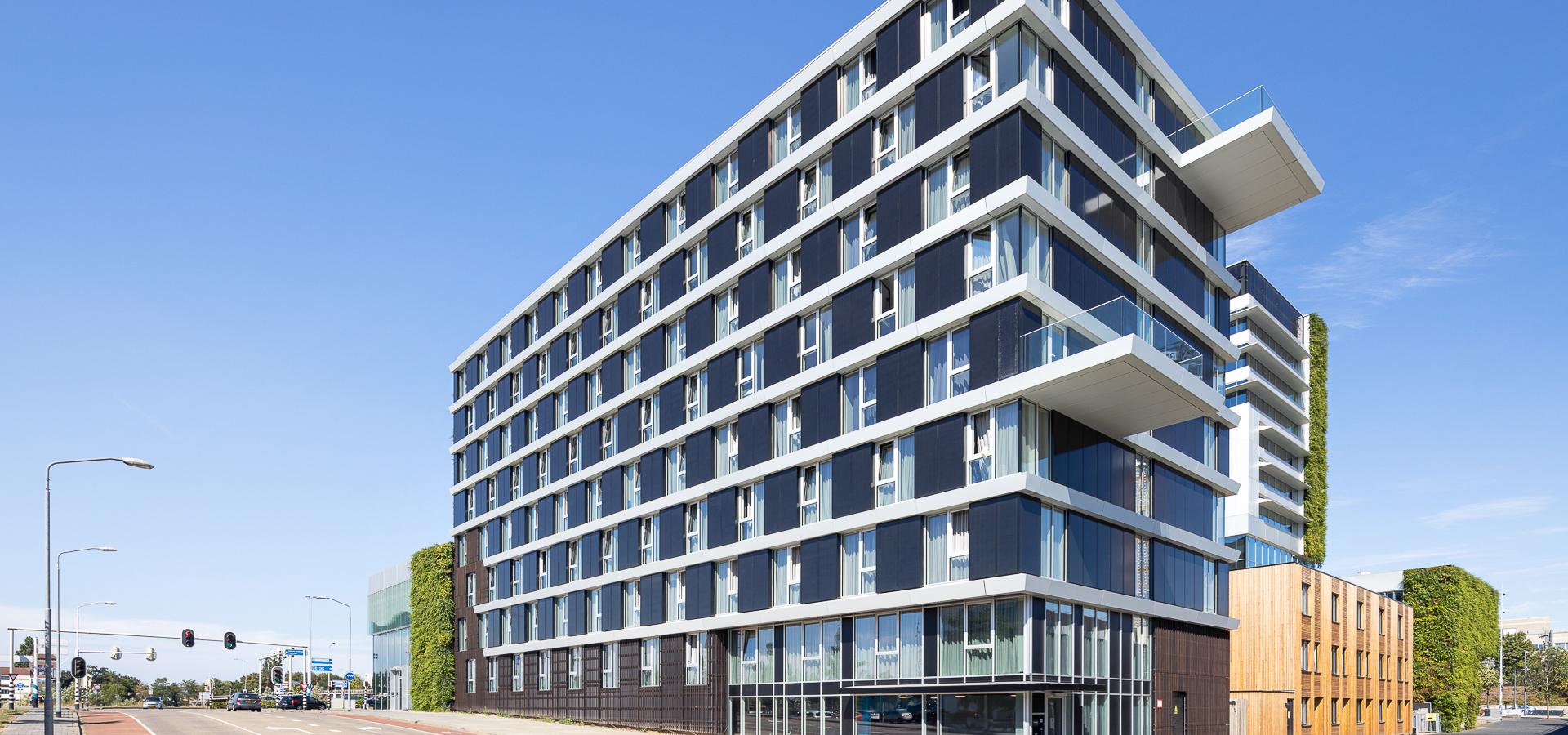
Thanks to the PV façade of this residential building in the Netherlands, 91 kWp of electricity is generated on a perfectly integrated 500 m² surface area. Image source: Stijn Poelstra
The façade as superstar
The problem with conventional systems in winter is primarily due to the position of the sun: While in June the sun is at its zenith and flat-roofed systems are optimally exposed to sunlight, in winter its path drops to a flat angle.
The consequences are drastic: a module on a typical flat roof often produces more than five times less electricity in December than in June – even though the amount of daylight has only halved. The reason for this is the unfavourable angle of incidence.
This is where the façade comes into its own. As the sun is low on the horizon in winter, the sun's rays hit the vertical modules at the perfect angle. While the roof system struggles in December, the façade delivers significantly higher yields throughout the winter months. The façade thus acts as a highly efficient supplement, delivering exactly when the residual load on the grid is at its highest.
Additional effects such as the albedo effect – the reflection of the sun's rays by a blanket of snow on the ground – further increase the yield of vertical surfaces in winter, while the modules are never covered by snow due to their vertical orientation.
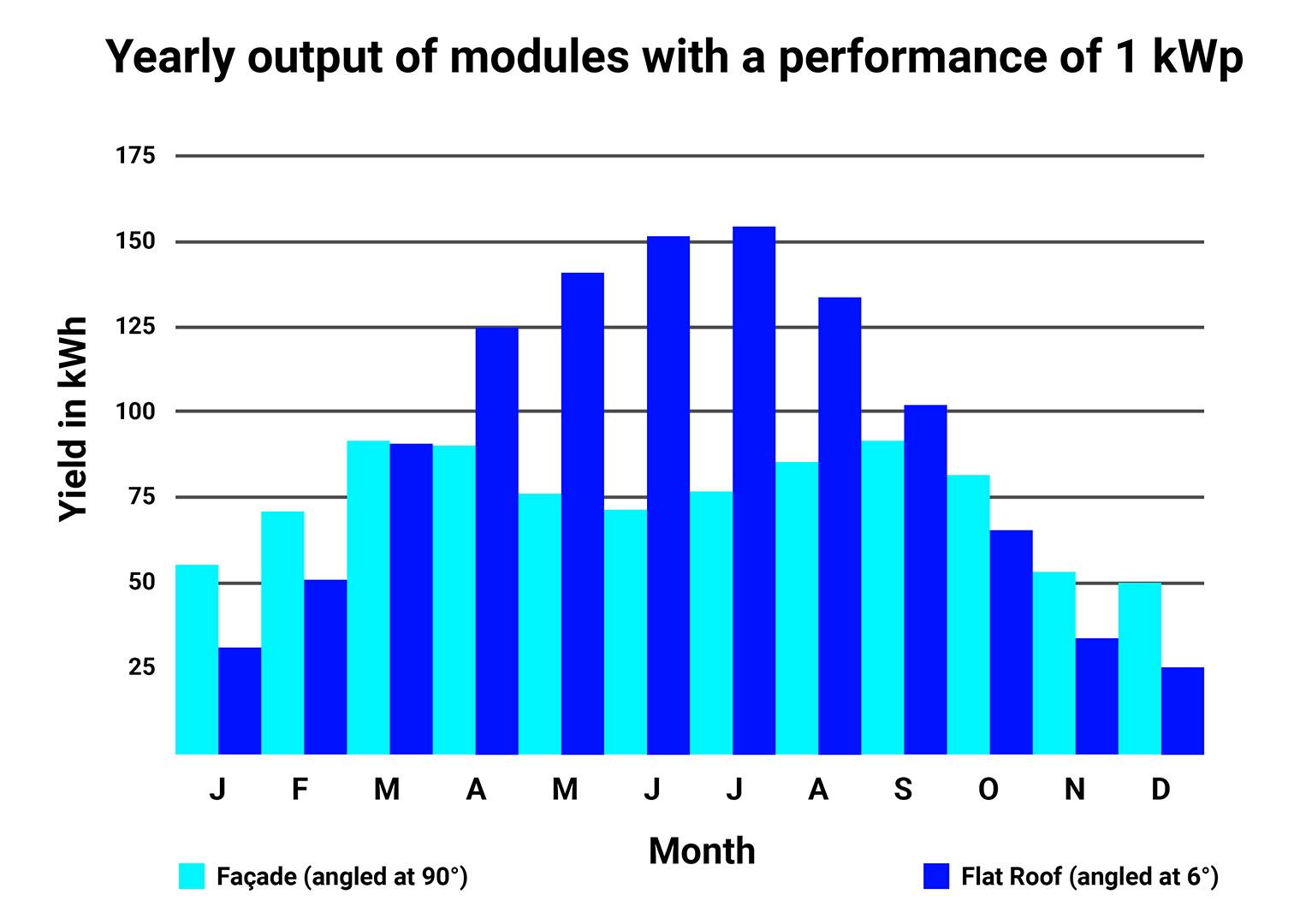
The graph clearly shows how the modules' performance is distributed over the course of a year. The façade generates the most electricity during the winter months, thus perfectly complementing the roof system.
Added value throughout the year: harmony in generation
Moreover, the solar façade is not purely a winter specialist. In summer, too, it offers a decisive advantage for load management: the temporal shift of production peaks.
While rooftop systems often produce a surplus at midday, facades take advantage of the low morning and evening sun. They produce electricity when demand in households and businesses (breakfast and after-work peaks) is at its highest. In combination with a storage system and a rooftop system, this creates a generation profile that massively increases a building's self-sufficiency rate.
Political foresight: additional subsidies for winter electricity
The strategic importance of façade PV has now reached the political level. In Switzerland, this is rewarded by specific subsidy instruments such as the tilt angle bonus (additional bonus for systems with a tilt angle of at least 75 degrees).
There is also a lot of movement in our neighbouring countries: Germany offers incentives for building-integrated photovoltaics (BIPV) through various subsidy programmes and tax exemptions, while in Austria, the EAG investment subsidy is often supplemented by innovation bonuses for architecturally integrated projects. Local initiatives such as the climate bonus in Frankfurt or cantonal façade subsidies such as those in the canton of Obwalden show that the façade is recognised and subsidised as the power plant of the future.
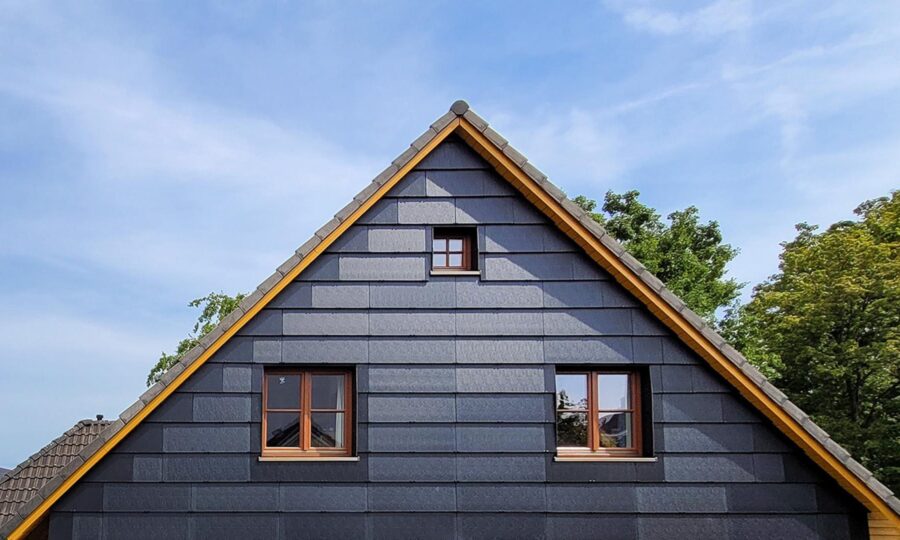
Even a small area can make a big difference when renovating a house, as shown here by the MATCH Slate Creek Gratine façade with an output of 3 kWp. Image source: Dachdecker W. Porstendorfer
Aesthetics meets high technology: Megasol solutions
At Megasol, we don't see the façade as a compromise, but as an aesthetic opportunity. Our systems prove that highly efficient energy generation and modern architecture can merge:
- Individually integrated: Tailor-made solutions for complex façade layouts with our FAST system and custom-made, frameless modules in all shapes and colours.
- Systematic integration: With NICER, LEVEL Up and MATCH, we offer standardised systems that completely replace the façade, reduce installation time and at the same time meet the highest aesthetic standards.
- Technological leaders: Our framed standard modules M450 & M490 can also be mounted on the façade using the LOCKIN system and set the highest standards in terms of efficiency.
Conclusion
The solar façade makes an essential contribution to the successful energy transition. It smooths the seasonal production curve, utilises unused space and enhances the architectural value of properties. Anyone building or renovating today should plan the building envelope not only as a protective shield, but also as an active energy supplier.
Our experts are on hand to help you achieve the most cost-effective implementation: we have detailed knowledge of the current subsidies available and can support you with precise, project-specific calculations.