
Easier than you might think: solar modules on an existing building envelope
Not every PV project starts from scratch. Impressive solutions can also be achieved on existing buildings using standard and bespoke modules. On the roof and on the facade, with framed or frameless modules. And this can usually be done with minimal effort.
The advantages
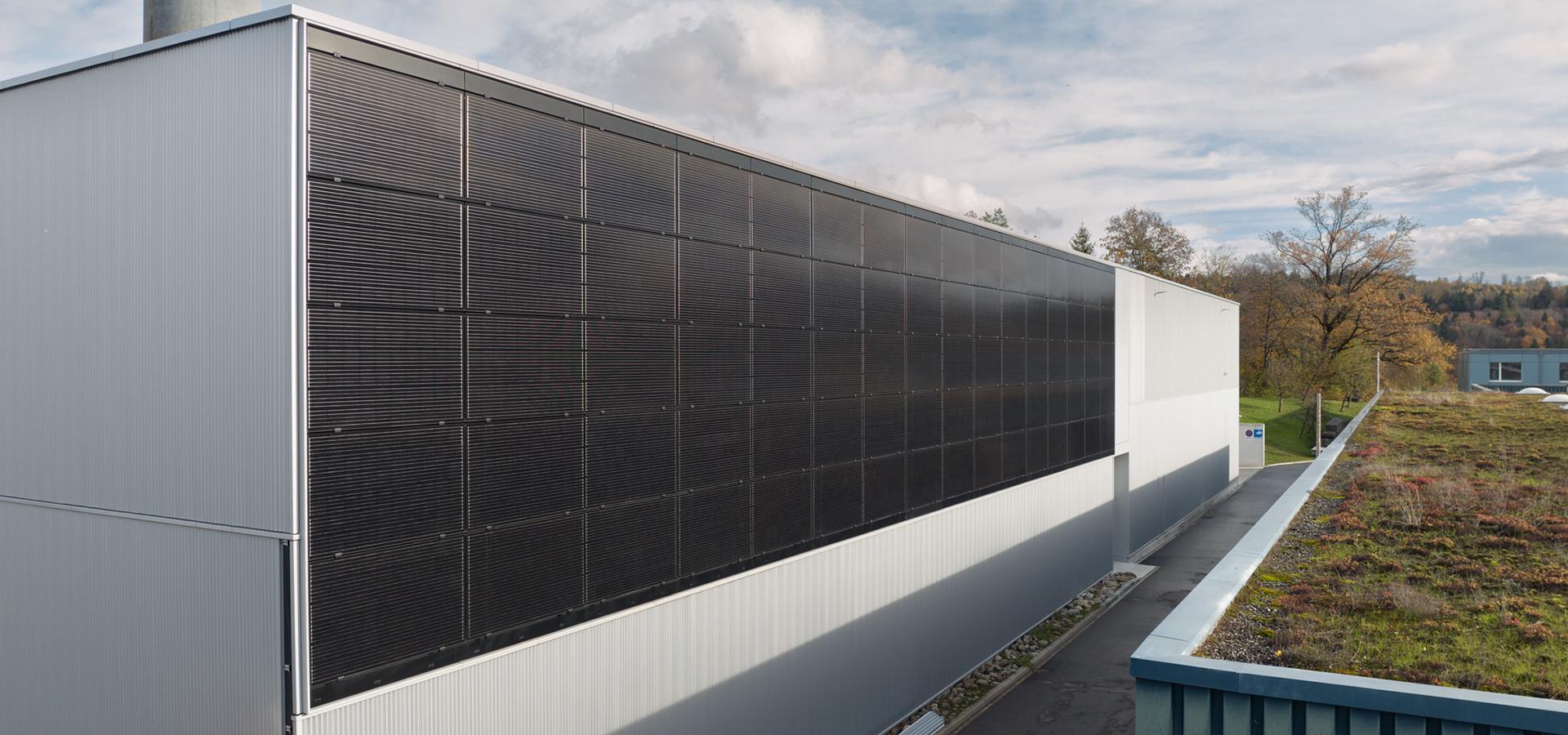
Retrofitting solar modules to an existing building envelope has many advantages: the structure remains intact; the modules are mounted using a mounting system or suspended from the façade. This is often the most direct route to a fully functional system – without the need for structural alterations or new-build costs. Thanks to standardised sizes within the industry, our modules can be integrated into any structure, offering you maximum flexibility.
Two module types, two systems, many possibilities
The choice of module depends not only on the power output but also on the design requirements of the project.
Framed standard modules – M490 (490 Wp, all-black) and M460 ZRM+ (460 Wp, anti-glare) – are available from stock and cover the majority of BAPV projects. They can be installed using LOCKUP (clamping system) or LOCKIN (Inlaying system), in landscape or portrait orientation, on roofs and facades.
Frameless glass-on-glass modules offer additional design flexibility: colour, glass surface (e.g. ZRM+, colour-printed, translucent) and size can be customised. This makes them the first choice when the system is intended to blend architecturally into the building – e.g. on facades that must not look like a ‘solar installation’. They are installed using LAYIN (Inlaying system for frameless modules) or LAYUP (clamping system for roofs/flat roofs). Further information on design options: megasol.ch/en/technology/design.
The substrate determines the mounting method
Before selecting a mounting system, the substrate must be analysed. The most common scenarios:
| Ventilated facade (VHF) | Wall bracket (any manufacturer) → battens or aluminium profile → sheet metal adapter → Megasol system |
| ETICS | Threaded rod + injection mortar + universal adapter → Megasol system |
| Concrete / brick wall | Concrete screws or anchors + universal adapter → Megasol system |
| Sandwich panel / trapezoidal sheet metal | Fixing to the high rib + sheet metal adapter + cross connector → Megasol system |
The following applies to all mounting types: The transition to the Megasol support system is made either directly via a sheet metal adapter or using a universal adapter (Schletter, K2). Wall brackets from Hilti, SG Weber, etc. are tried and tested in professional practice and fully compatible.
An overview of the mounting systems
LOCKUP – Clamping system for framed modules (30–40 mm frame). Suitable for both landscape and portrait orientations. Compatible with Megasol, Schletter and K2 mounting systems.
LOCKIN – Inlaying system for framed modules. Slide the module in, lower it, fit the locking plate – done. No tools required for module fixing; modules can be easily replaced during operation.
LAYUP – Clamping system for frameless glass-on-glass modules. Landscape orientation recommended. 4 modules per clamping bracket; allow for a 10 mm expansion joint.
LAYIN – Inlaying system for frameless modules with the same installation procedure as LOCKIN. Ideal for facades with custom modules.
Which system is suitable for which application?
Framed modules → LOCKUP or LOCKIN.
Frameless / custom modules → LAYUP or LAYIN.
Facades with specific design requirements → LAYIN with custom-configured GG modules.
Conclusion
BAPV works on almost any substrate – provided the connection and installation system are properly coordinated. Framed modules (M490, M460 ZRM+) with LOCKUP or LOCKIN are the quickest solution for the majority of projects. Frameless custom modules with LAYUP or LAYIN open up design possibilities – for facades where the module should blend in rather than stand out. The Megasol team is happy to assist with any technical queries regarding system planning or structural analysis of the fixings.
PS: This article deliberately focuses on our solutions for surface-mounted photovoltaics. You can find our systems for integrated solar modules here.